
Between the Two Ponds
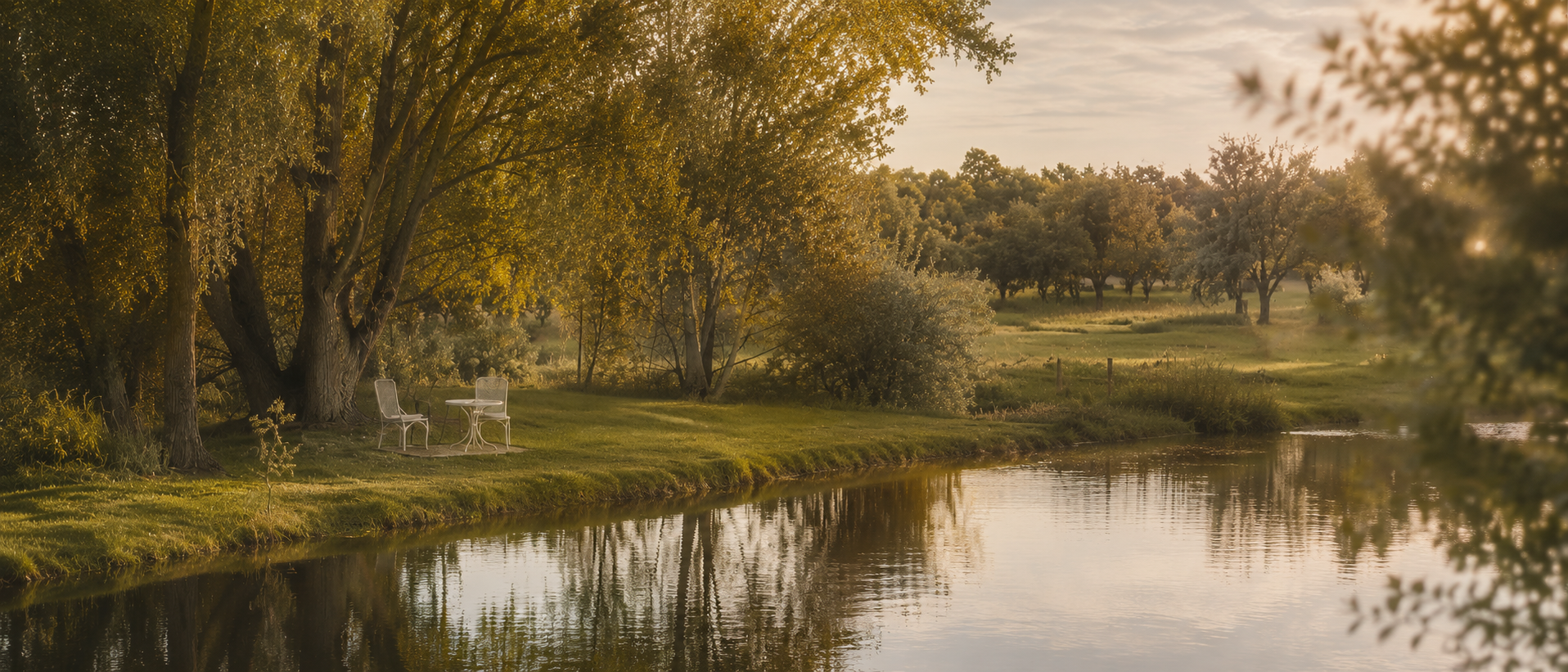
One passage. One idea. A few quiet minutes. Short devotional readings for people being formed by grace, written from a small chair beside still water in Falcon, Colorado.
Pull one up. Read slowly. There is no hurry here.
Blocked, or Held
How do you know whether your prayer is blocked by something in you, or whether God is simply holding you in a silence he intends to use?
"Wait for the Lord; be strong, and let your heart take courage; wait for the Lord." (Psalm 27:14)
So how do you tell the difference? How do you know whether your prayer is blocked by something in you, or whether God is holding you in a silence he means to use? There is no clean test, and anyone who offers you one should be distrusted. But there is one thing worth noticing, and it helps.
A blocked prayer usually has a name. If you sit still long enough and are willing to be honest, the thing in the way will surface. It will have a face. It will come with a conversation attached, or a purchase, or a habit, or a person you have not spoken to in six years. The Spirit does not play hide and seek about sin. When he convicts, he is specific.
Silence is not specific about anything. You search and search and nothing comes up, no name and no face, and the searching itself starts to feel like an accusation you are leveling at yourself. That is not conviction. That is anxiety wearing conviction's coat. So do the honest thing once. Search. Ask him plainly to show you. And if he shows you something, deal with it. But if he does not, then stop digging and start waiting, because you are not blocked. You are being held, and the holding is not punishment.
The Word and the Son
Every garden has a gate, and the Psalms tell you exactly where theirs is.
"Blessed are all who take refuge in him." (Psalm 2:12)
Every garden has a gate, and the Psalms tell you exactly where theirs is. Psalm 1 and Psalm 2 are the archway. Neither is really about a single subject; they are the two pillars you walk between to get in, and each hands you something you will need once you are inside. Psalm 1 hands you the Word of God: blessed is the one whose delight is in the law of the Lord, who meditates on it day and night. Psalm 2 hands you the Son of God: it ends with the nations raging and the kings scheming, and then it turns and says, blessed are all who take refuge in him. The Word and the Son. That is what you carry through the arch.
There is another way people try to get in, and it does not work, though most of us have tried it. You can come to prayer wanting an outcome, wanting a resolution, wanting God to do a particular thing on a particular timeline, and you can climb the wall and get in that way. But you will find nothing inside except your own anxiety wearing a religious hat. The garden was never a vending machine, where the right sequence of words drops the desired result into the tray.
You come in with the Word, and you come in with the Son, and you come in to be with someone. That is the whole point of the place. Everything else that grows there, every comfort and correction and joy, grows only because you came for him and not for it.
An Obedience That Costs Your Expertise
Then a carpenter got into his boat, and told a professional fisherman where to fish, in the middle of the day, in the deep water, which is exactly the wrong time and the wrong place, and any man in that trade would have known it.
"And Jesus said to Simon, Do not be afraid; from now on you will be catching men." (Luke 5:10)
Peter had fished all night and caught nothing. Then a carpenter climbed into his boat and told a professional fisherman where to fish, in the middle of the day, out in the deep water, which is exactly the wrong time and the wrong place, and any man in the trade would have known it. And Peter did it anyway.
That is the hinge of the whole story, and everything after it hangs on that one act, a man doing the thing that made no sense to him in the very place where he was the expert. The nets came up so full they began to tear. The other boat had to come. Both boats began to sink under the weight of it. And Peter, standing knee deep in more fish than he had ever seen, does not celebrate. He falls down and says, depart from me, I am a sinful man.
That is what happens when a man gets close enough to see who is actually in the boat with him. He does not feel worthy. He feels exposed. The blessing did not make him confident. The blessing made him aware. And Jesus does not leave. He says, do not be afraid.
This is where surrender begins, and notice where it begins: on a boat Peter owned, in water he knew, doing a thing he was certain would not work. It did not start with a decision made in a tent. It started with an obedience that cost him his expertise. That is usually where it starts for us too. Not with agreeing to something, but with letting Christ overrule the one place where you were sure you already knew better.
The No That Love Says
I dread saying yes to some things and I still cannot make myself say no to them, and if you have ever felt that particular kind of powerlessness, where the word is right there in your mouth and it simply will not come out, then you know exactly what .
"Fear of man will prove to be a snare, but whoever trusts in the Lord is kept safe." (Proverbs 29:25)
Do you have trouble saying no? There is a particular powerlessness in it, where the word is right there in your mouth and simply will not come, and you hear yourself agreeing to the thing even as your heart sinks. Somebody asks, and you say yes, and you are already tired. And it always traces back to the same fear. What would they think of me if I said no.
So we end up buying whatever anyone is selling. We say yes to the errand, the committee, the favor, the fourteenth thing this month, and we do it because we would rather be exhausted than disliked, and then we tell ourselves that this is what love looks like. But love is not the same thing as the inability to refuse.
Consider that God says no to us all the time. He says it often and plainly, even to things we wanted badly, even to things we were sure were good. Does that mean he does not love us? We know it does not. God is love, and sometimes love is precisely the thing that says no. No to what would harm you. No to what would hollow you out. A no is not the absence of love. A no can be the shape love takes when it sees further down the road than you can.
Which means your endless yes may not be kindness at all. It may be fear wearing the costume of kindness. So before you answer the next request, ask what is actually moving you. If even God, who is love, can say no in love, then you are permitted to, and the fear that would not let the word out was never love to begin with.
The One Remark
I will never forget one of my performance reviews when we lived in Colorado.
"Whoever trusts in the Lord is safe." (Proverbs 29:25)
It is a strange and revealing thing about the human heart, that a person can receive a hundred encouragements and one criticism, and it is the criticism he carries out to the car, turns over at the sink, takes to bed, and wakes with in the morning. The praise slides off. The single unkind word sinks in and stays.
Why should that be? Not because the criticism is truer than the praise. Often it is not. It sticks because of what it touches. The compliments only tell you what you already needed to be true, so they find no purchase and slide away. The criticism tells you what you have always been afraid was true, and so it holds. It is not new information. It is confirmation. It lands on a fear that was already there, waiting for a voice.
This is the tell that our safety has been resting in the wrong place. If a room's approval can lift you up, a room's disapproval can lay you flat, and you have handed strangers the keys to your soul. The person whose security sits in the opinion of others will be ruled by whichever opinion is cruelest, because the cruel one always confirms the fear.
Proverbs sends you somewhere safer. Whoever trusts in the Lord is safe. Not whoever is praised. Not whoever performs well enough to silence every critic, for that day never comes. So when the one remark lands and will not leave, do not argue with it and do not try to drown it under praise. Take it to God and ask him the deeper question. What is it in me that was already waiting to believe it, and have I been trusting the room to tell me who I am?
The Ring in the Nose
The fear of man is a snare, and I want you to sit with what a snare actually is, because we hear the word and think of something small. A snare is not a warning.
"The fear of man lays a snare, but whoever trusts in the Lord is safe." (Proverbs 29:25)
A snare is not a warning. It is a trap, and a trap exists to hold you in place so that something outside you can decide what happens next. Scripture calls the fear of man a snare, and the oldest readers pressed the picture further: the snare is not only a trap but a lead, a ring set through the nose. That is why the ring is there in the nose of the bull. It is not ornament. It is control. An animal strong enough to break a man in half is walked wherever the herdsman wills, by the softest part of its face, because the alternative hurts more.
Fearing what other people think of you is that ring. And here is what fools us: it does not feel like a trap. It feels like a carrot. It feels as though something good is just ahead, and if we can gather a little more approval, a little more of their good opinion, we will finally be able to rest. So we lean forward and take one more step, head down, and go where we are led. The carrot is the disguise. The ring is the mechanism.
You will not feel the ring. That is the whole genius of it. No one who is led by the nose feels the ring. He feels only the pull, and he names it ambition, or service, and sometimes he even names it love. Only trust unhooks it, because the one who trusts the Lord is no longer for sale to the room. So ask the question that reaches the bottom of it, and answer it honestly. Who has been walking you around?